
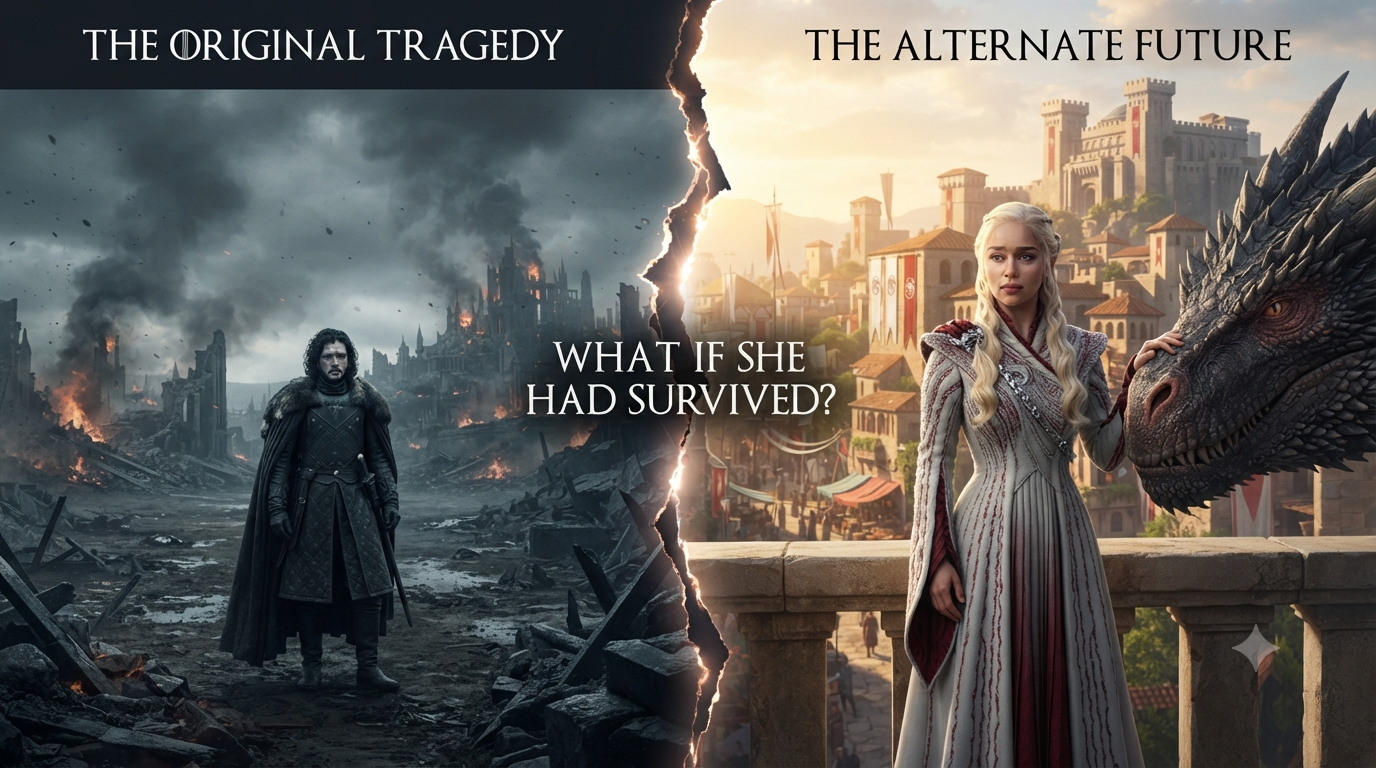
The Dagger in the Heart That Divided a Fandom
When the final season of HBO's Game of Thrones drew to a close in May 2019, it left an indelible mark on television history—though perhaps not entirely the one creators David Benioff and D.B. Weiss had hoped for. Among the most controversial narrative beats of the series finale, "The Iron Throne," was the sudden, tragic assassination of Daenerys Targaryen at the hands of her lover and nephew, Jon Snow. After watching her descend into a fiery madness and burn King's Landing to the ground, Jon made the agonizing choice to plunge a dagger into her heart to save the realm from her tyrannical vision of "breaking the wheel."
Yet, years later, the question lingers in forums, convention panels, and late-night fan debates: What if Daenerys hadn't died? What would Westeros look like under a queen who survived her own darkest impulses, or alternatively, one who fully embraced absolute power without interruption? Let us dive deep into the alternate history of Westeros if the Mother of Dragons had lived to rule.
1. The Immediate Aftermath: Justice, Retribution, and Fractured Alliances
If Jon Snow had hesitated, or if Drogon had incinerated Jon before—or immediately after—he struck the fatal blow, Daenerys Targaryen would have found herself standing atop a mountain of ash as the undisputed, albeit feared, Queen of the Andals and the First Men.
The immediate political crisis would not have been external enemies, but internal dissent. Surviving lords and military leaders like Yara Greyjoy, Gendry Baratheon, and the newly freed representatives of the North would have faced an impossible choice: bend the knee to a monarch who had just weaponized a dragon against a surrendered city, or face immediate annihilation.
The Fate of Jon Snow: Had Jon survived, imprisonment would have been certain. Unlike the show's neat exile to the Night's Watch (which itself made little sense given that the White Walkers were defeated and the Wildlings became allies), an alive and imprisoned Jon would have represented a perpetual rallying symbol for rebellious houses.
Sansa Stark and the North: Sansa would have immediately demanded complete independence for the North. Daenerys, having stated her intention to rule all Seven Kingdoms, would have faced an immediate secession crisis. Would she burn Winterfell just as she burned King's Landing, or would diplomacy—or Tyrion Lannister's counsel—prevail?
2. Tyrion Lannister’s Impossible Dilemma as Hand of the Queen
In the actual series finale, Tyrion’s decision to renounce Daenerys and convince Jon to kill her stemmed from the realization that she could not be reasoned with. If Daenerys lived, Tyrion’s role as Hand would become a high-stakes psychological tightrope walk.
"You are my Hand. Do you know what that means? It means you speak for me. It means your voice is my voice." — Daenerys Targaryen
Tyrion would have had to manage a ruined capital with zero economic infrastructure, millions of traumatized survivors, and an army of Dothraki and Unsullied who expected to continue sacking and conquering. Daenerys's grand vision of "liberating the world" would mean her armies would not simply rest in Westeros; they would look across the Narrow Sea to Essos, or south to Dorne and the Reach, to enforce her absolute rule.
3. The Magical and Mythological Fallout: The Role of Drogon
One of the most poetic yet unexplained elements of the finale was Drogon melting the Iron Throne instead of burning Jon Snow. If Daenerys lives, Drogon remains the ultimate deterrent of geopolitical rebellion.
However, the presence of a living dragon alters the magical balance of power permanently. Westeros had spent centuries celebrating the extinction of dragons because they made conventional warfare obsolete and corrupted absolute power. With Drogon alive, no lord could ever plot treason without looking to the skies. Over time, this might have led to a Pax Targaryena—a forced, fearful peace maintained entirely through the threat of incinerating dissenters.
4. A Benevolent Tyrant or a Cycle Unbroken?
The core thematic question of George R.R. Martin's universe is whether power corrupts absolutely and whether institutional cycles can truly be broken. Daenerys famously declared her intention to "break the wheel," but by destroying King's Landing, she proved that she was simply replacing the old spokes with her own.
If she lived, two divergent paths emerge from fan analysis:
- The Reformer Path: Guided by Tyrion and perhaps softened by the horror of her own actions in King's Landing, Daenerys pulls back from total tyranny. She invests heavily in rebuilding, abolishes remaining regressive laws across the kingdoms, establishes public institutions, and eventually transitions toward a constitutional or council-led governance, realizing that fear alone cannot sustain an empire.
- The Mad Queen Path Unchecked: Believing completely in her divine right and messianic complex, Daenerys brooks zero opposition. The North is forcefully subjugated, Dorne is brought to heel, and any whispering lord is silenced by dragonfire. She becomes the very monster she set out to destroy, proving her father, the Mad King Aerys II, right in spirit if not in execution.
Conclusion: Why the Tragedy Resonates More
While an alternate ending where Daenerys rules could have offered fascinating political drama, her death served a vital thematic purpose for the television adaptation. It forced the characters—and the audience—to confront the dangerous allure of charismatic conquerors. Even if the execution in Season 8 felt rushed to many viewers, the fundamental idea that absolute power corrupts absolutely remains the beating heart of the story. Ultimately, Daenerys dying at the hands of the man she loved sealed her fate as one of television's most complex, tragic figures—a conqueror who won the world, but lost everything in the process.